
The typical first-time homebuyer is older than ever
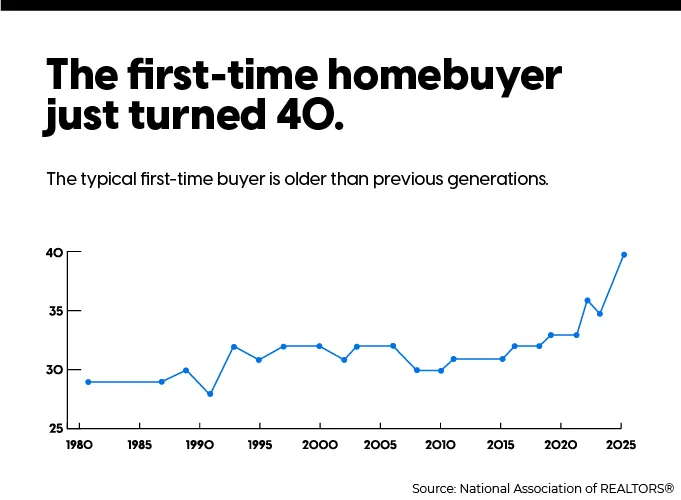
It looks like 40 is the new 30. Fifteen years ago, the median age of a first-time homebuyer was 30. It’s gradually increased since then, and now we’ve reached the oldest age since 1981, when NAR started their surveys.
Delaying homeownership can have long-term financial consequences. Fortunately, there are ways to make homebuying more attainable and affordable, so people can reap the rewards sooner — and longer.
First-time buyers are becoming a smaller share of the market
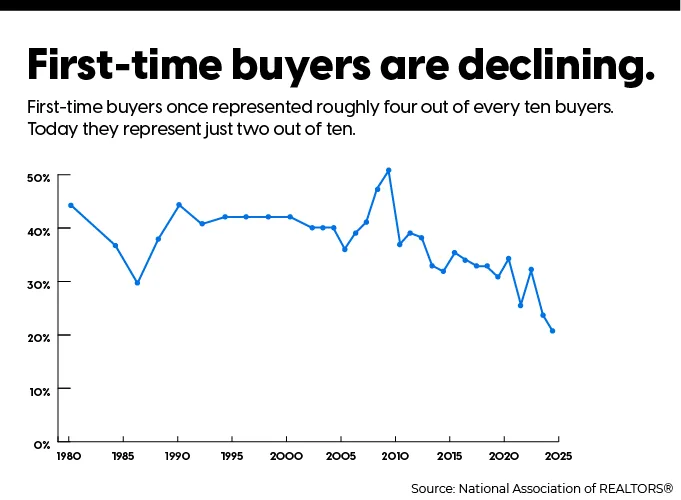
Not only are first-time homebuyers older, there are fewer of them. In 1981, first-time buyers accounted for 44% of the market. While this dipped to 30% with the stock market-fueled recession in 1987, it rebounded within 4 years and stayed around 40% until it hit another drop right before the Great Recession of 2007–2009. After a steady recovery to 50% in 2010, the trend has been downward until we hit the lowest on record: 21%.
Why are people buying homes so much later?
It’s clear first-time buyers are older and their share of the market is smaller. The question is, why are people delaying their first home purchase? Maybe it’s not the perfect storm, but several factors have come together:
- Rising home prices
- Student loan debt
- Higher rents
- Saving for a down payment
- Economic uncertainty
- Delayed family formation
- Changing life milestones
Individually, each of these could make it more difficult to buy a home. Put two or more together, and it can feel daunting. It doesn’t have to be. Home prices and the economy are beyond any individual’s control, but with more than 90% of first-time buyers using a home loan to make their purchase, it makes sense to focus on home loans and financing programs to make buying more affordable.
The homebuying advice we inherited was built for a different era
Conventional wisdom may no longer be wise. Tradition assumes that:
- First-time homebuyers are young
- Affordable starter homes are readily available
- Debt (student loans, credits cards, car loans) is not a consideration
- The economy is stable, if not booming
The traditional response to these conditions has been for buyers to:
- Save 20% for a down payment
- Avoid the expense of mortgage insurance
- Pay off debt
- Wait until their finances are perfect — with credit scores to match
- Only consider a conventional 30-year fixed-rate mortgage
This isn’t bad advice. A higher down payment and strong credit could result in a lower interest rate. Less debt could create the opportunity to borrow more. A conventional 30-year fixed-rate mortgage offers predictable monthly payments spread out over a longer time. A 20% down payment means no monthly mortgage insurance.
But if first-time buyers don’t fit the old mold, home loans can adapt, too.
Buying at 30 vs. buying at 40: how the timeline changes
Homebuyers may look only at the immediate transaction. They’re buying a home, so they’ll pay a certain amount each month for their loan, property tax and homeowners insurance. They’ll also have maintenance and repair costs.
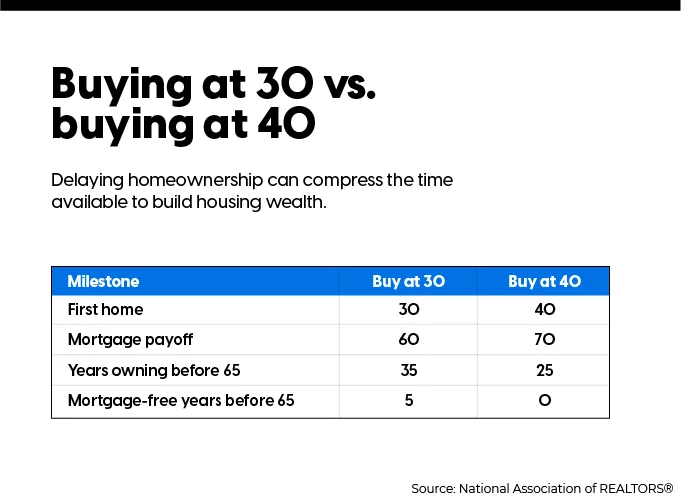
However, looking at the long term there’s a clear cost to waiting.
- The more years spent renting, the more money that goes to paying someone else’s mortgage — the landlord’s.
- Years of equity lost. Equity is the difference between what’s owed on a home loan and what the home is worth. A buyer’s equity grows in two ways: As their home increases in value and as they pay down the principal on their mortgage.
- By waiting, it becomes more difficult to afford to move up to a bigger or more desirable house.
- And finally, while the time it takes to pay off the mortgage may be the same, the borrower will be older and have fewer earning years to pay for the home.
The 20% down payment myth
If there’s one myth about mortgages that needs to be busted, it’s that a borrower must pay 20% down.
Fact: A borrower doesn’t need a 20% down payment to buy a home.
In 2025 the typical first-time homebuyer down payment was 10%. However, below 20%, mortgage insurance becomes part of the financing equation. (That’s not necessarily a bad thing. We’ll look at it in a minute.)
There are loans with low minimum down payments, and some (VA and USDA) that require no down payment at all. Particularly helpful for first-time homebuyers are FHA loans (3.5% minimum down) and Freddie Mac Home Possible® and Fannie Mae HomeReady® loans (as little as 3% down).
What if that still seems out of reach? Consider gift funds. 19% of first-time buyers used money from a family member or friend for their down payment. There are documentation requirements (gift letter, source of funds) and potential tax implications for the giver (consult a tax advisor), but if this is a viable option, it can be a homebuying boost.
One more thing. There are many state, local and mortgage lender-backed down payment assistance (DPA) programs. Some are outright grants, some are loans forgiven over time and some require repayment. They usually have income and/or property location restrictions but it’s an option well worth exploring with a loan originator.
Mortgage insurance isn’t always the enemy
Think of mortgage insurance as a useful tool when a 20% down payment is out of reach. Let’s say a borrower chooses a conventional loan and saves enough for a 5% down. Then they get another 10% with gift funds and a local DPA program. There’s still a 5% gap. That’s where mortgage insurance (MI) comes in.
Lenders require MI because when a borrower takes out a loan for a higher percentage of a home’s value, the loan is a bigger risk. MI insures the lender so they can make loans they wouldn’t consider otherwise. Borrowers pay for that insurance, usually as part of their monthly mortgage payment.
MI doesn’t last forever. For a conventional loan, once the principal balance is down below 80% loan-to-value (or put another way, the borrower has 20% equity in their home) they can ask to have the MI removed. Loan programs vary, so it’s important to understand how MI works for the loan chosen.
It’s true MI adds to monthly costs, but it can make buying a home possible sooner.
Student loans don’t automatically disqualify buyers
Does student loan debt have an impact on first-time homebuyers? Yes. 43% reported that student loan debt delayed their homebuying. Does it mean first-time buyers can’t buy? No. 33% carried this debt and still bought a home. The important measurement is the debt-to-income ratio. (That’s the relationship been gross monthly income and recurring debt.) Different loan types may have different ways of considering the impact of deferred loans or loans in forbearance, so talking to a loan originator is the way to learn more.
Today’s buyers have more options than previous generations
Buyers have so many loan choices today. 70% of first-time buyers chose a conventional mortgage, while 10% took an FHA loan and 13% qualified for VA. FHA has a minimum down payment of 3.5%, some conventional loans go as low as 3% and USDA and VA can be 0% down. Adjustable-rate mortgages (ARMs) can be a good choice for buyers who plan to sell or refinance within the lower initial fixed-rate period of the loan, or in certain rate environments.
One increasingly popular mortgage is the Non-QM loan, which allows alternative income documentation (no W-2s or tax returns required) to accommodate business owners, 1099 contractors, gig workers and others with less-conventional income streams.
Maybe it’s time to update the rules
First-time homebuyers are older than ever; affordability has changed their homebuying journey and they have different concerns than previous generations. It’s time to make sure lending advice has evolved to match this new reality.